Using the reversed() function is another way to traverse the python list in reverse order. The reversed() function does not modify the content of the python list. It returns an iterator to read the list values of the list in reverse order, and the content of the original list remains unchanged. Create a python file with the following script to check the use of the reversed() function for reading the list in reverse order. Create a python file with the following script to traverse the content of the python list in reverse order. The for loop has been used here to read and print the original values of the list.

The while loop has been used to traverse the list backward. The index variable has been used to set the last index of the list, and it has been used in the loop to set the termination condition. The while loop will be iterated until the index value becomes 0.
The original and the reversed values of the list will be printed with the tab space. The reverse() function permanently reverses the python list's content without creating a new list. Create a python file with the following script to check the way reversing the items of the python list permanently by using the reverse() function. A list of 6 elements has been declared in the script. The original and reversed lists will be printed after executing the script.

Sometimes it requires reading the python list in reverse order for programming purposes. Reversed () function returns an iterator to accesses the given list in the reverse order. Let's iterate over that reversed sequence using for loop i.e. It will create a temporary revesed list Let's use this in List comprehension to iterating over the list in reverse i.e. The list is one of the useful data types of python to store multiple data in a single variable.

Sometimes it is required to read the data from the list in reverse order or backward. That means the last element of the list will be read at first, and the first element of the list will be read at last. This can be done by using the built-in function of python or by using extended slicing, or by using the loop. Different ways to reverse the python list have been shown in this tutorial.

The simplest way to reverse a list is to iterate through the list in reverse order. While iterating, we can add each traversed element to a new list which will create a reversed list. Your first approach to iterating over a list in reverse order might be to use reversed(). This built-in function was specially designed to support reverse iteration.

With a list as an argument, it returns an iterator that yields the input list items in reverse order. Here, a for loop with two different variables will aid in iterating a dictionary through dict. As a result, individual keys and values of the given dictionary can be accessed individually.
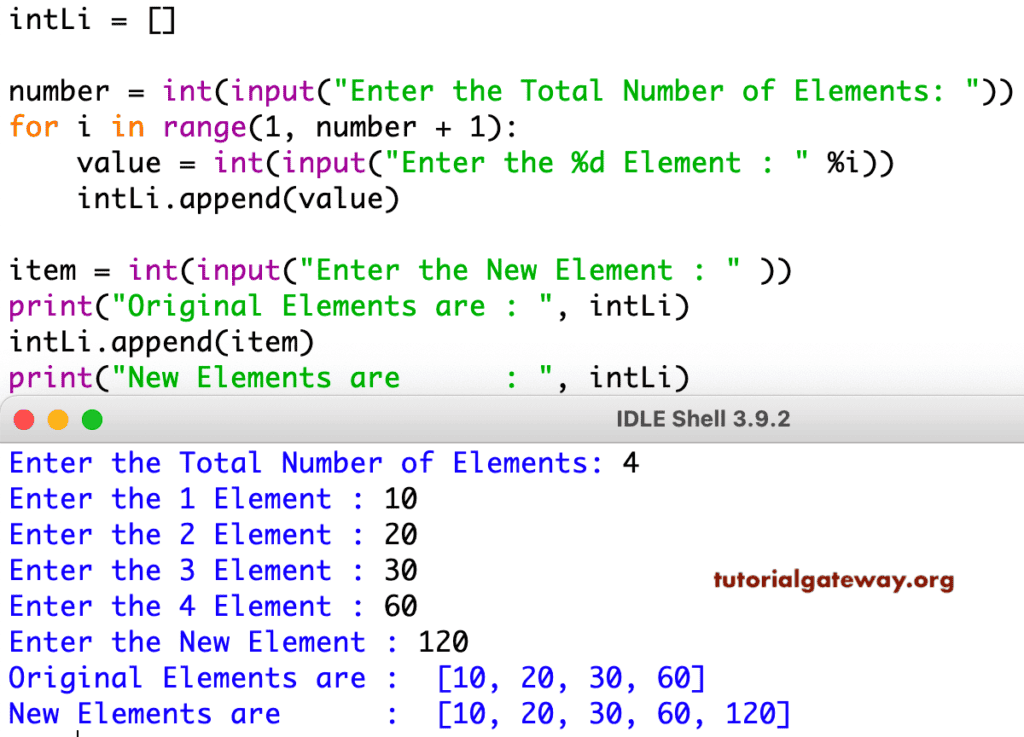
The items() method of the dictionary object is responsible for returning a list of tuples, with every single tuple having a key and a value. Thus, you can print a single dictionary at a time. The latter approach assigns both the keys and the values simultaneously. Create a python file with the following script to read the python list in reverse order by using the range() and len() functions. In this tutorial,you'll learn how to use Python to reverse a list.

Python comes with a number of methods and functions that allow you to reverse a list, either directly or by iterating over the list object. You'll learn how to reverse a Python list by using thereversed()function, the.reverse()method, list indexing, for loops, list comprehensions, and the slice method. This special method returns an iterator over the items of the current list in reverse order. However, .__reversed__() isn't intended to be used directly.
Most of the time, you'll use it to equip your own classes with reverse iteration capabilities. The magic in this list comprehension comes from the call to range(). In this case, range() returns indices from len - 1 back to 0. This makes the comprehension loop iterate over the items in digits in reverse, creating a new reversed list in the process.
We can use the reversed() method to reverse the list. The reversed() method takes an iterator like list as input and returns a reverse iterator. After that, we can create the reversed list from the iterator using a for loop as follows. To iterate through a list in python we can easily use the range() method.

This method returns a sequence of items and it can be used to combine a for loop with range() function to iterate over a list. Again, a subtle detail to note is that if the input list changes during the iteration, then the iterator sees the changes. This slicing returns all the items from the right end of the list (len - 1) back to the left end because you omit the second offset. The rest of the magic in this example comes from using a value of -1 for step.

When you run this trick, you get a copy of the original list in reverse order without affecting the input data. Iterate over the list using for loop and reversed() reversed() function returns an iterator to accesses the given list in the reverse order. This kind of for loop iterates over an enumeration of a set of items.
It is usually characterized by the use of an implicit or explicit iterator. In each iteration step a loop variable is set to a value in a sequence or other data collection. This kind of for loop is known in most Unix and Linux shells and it is the one which is implemented in Python. In the above example, you can see that we've called the id() function to print the memory address of the list. And you can assert that id values for input and output lists are the same. Reverse () method reversed the list in-place and didn't create a new copy.

In the above program, you saw the use of list comprehension to reverse a list. The first value is the starting value which is the ending index of the list. The second value is the index just preceding the starting index because a for loop traverses up to an element just before the ending index i.e, excluding the stop index.
The step value is -1 which means that the traversal has to be done in reverse order. In the above example, the function reverseList returns the output of the reversed which is an iterator object pointing to the end of the list. You saw the use of this iterator object to print the elements in the reversed order. There is also another method called reversed() which can be used to reverse any data-type such as a list, tuple, string, etc. The difference between the reverse() and reversed() method is that the reversed() method does not reverse the list in-place or modify it.

Neither does it return another reversed copy of the original list. What it does is, it will return a reversed iterator that points to the last element to be used to iterate the list and get the elements in reversed order. Lists are probably one of the most important and widely used data types in Python. A list in Python is a data-type that is used to store multiple values, elements, or other data types. Lists are changeable, can contain multiple duplicate values, and are ordered.

It is also possible to also perform indexing and slicing with lists. The items in the lists have an order, so the elements remain in the same order in which they were inserted. Moreover, you can change the list, add, or remove elements from the list. In comparison to lists, tuples, and sets, you store key-value pairs rather than individual values. In this article, we covered the core approaches to iterating over a dictionary in Python. These comprise the dictionary methods values(), keys(), and items with the aid of a for a loop.
Beginner coders and coders coming from other programming language often like to use indexing schemes to manipulate sequence elements (they don't know better). For comprehensibility, I wanted to include the following method to reverse a list using nothing but simple indexing, a for loop, and the range() function. In Python to iterate over a list in Reverse order, we can apply the loop and reversed() method. This method takes only a single argument that is sequence and it returns an iterator item in reverse order.

These are functions and can be very handy for many tasks. We have been looking at apply() in this chapter, but will come back to some more when talking about lists and data frames. To conclude, in this comprehensive guide, you looked into what lists in Python are, and the different ways through which you can reverse a list in Python.

This article discussed techniques such as reversing a list using the built-in reverse() and reversed() methods, list slicing, for loops, and list comprehensions. You also got to know which ones are efficient and can be used compared to others. Our ReversedIterator class receives the list we want to do reverse iteration in the constructor.

The iterator() method builds a new ListIterator when it's called by a client and returns an Iterator that will work based on this ListIterator. When the Iterator methods are called we use the created ListIterator to perform the reverse operations. We made this class generic so it can be used with any data type. Supposing that our list is holding a considerable number of items that makes the reverse operation itself to impact the overall application performance. It doesn't make sense to spend CPU cycles reversing the list if what we want to do is just to iterate its elements in the reverse order. In this example, we have defined by_value() and applied it to sort car_mileage items' by value.

Then you used sorted to iterate through the dictionary in sorted order (). Sorted () is told to order incomes by the main function (by_value ()). Items() returns the value of the second element of each object (item ).

Often we need to reverse a list, delete an element from the list, adding or inserting an element to the list or to merge two lists in python. In this article, we will look at different methods to reverse a list in python. To solve this problem we can apply the range() function. So far, you've seen a few tools and techniques to either reverse lists in place or create reversed copies of existing lists. Most of the time, these tools and techniques are the way to go when it comes to reversing lists in Python.

However, if you ever need to reverse lists by hand, then it'd be beneficial for you to understand the logic behind the process. The reversed() method creates a reverse iterator to traverse through the list in reverse order. This is a powerful technique that takes advantage of Python's iterator protocol. Besides, it returns an iterator pointing to the last element of the list. You can iterate over it and get the items in the reverse order. In Python, dictionaries are a form of collections.

This means that instead of using an index to refer to your values, you use a key, which is a one-of-a-kind identifier. To access either the keys or the values individually, you will need to iterate over the given dictionary. Python's built-in reversed() function allows you to create a reverse iterator for an existing list or sequence object.

This is a flexible and clean solution that relies on some advanced Python features—but it remains readable due to the clear naming of the reversed() function. It's interesting to see that the least readable and least concise methods 4 and 5 are also slowest! Note that we didn't convert the iterator returned by the reversed() method to a list—otherwise, it would have added a few milliseconds to the result. The range(len-1, -1, -1) function returns an iterator that starts with the index len-1 which is the last index in the variable names.

It goes all the way to 0 using negative step size -1. The reversed function returns the elements in reverse order from an iterable object. But Python does have a built-in reversed function. If you wrap range() inside reversed() , then you can print the integers in reverse order. Range() makes it possible to iterate over a decrementing sequence of numbers, whereas reversed() is generally used to loop over a sequence in reverse order.
In this article we have seen how to reverse a list in python using a for loop, slicing, list comprehension, reverse() method and reversed() method. Reversed() is a python built in function which returns a reverse iterator over the list. We are using the range function but starting with the position -1. This value helps us read the list from the last index value also we iterate through steps of -1.

In the below example we start at a position which is measured by taking the length of the list and then taking -1 steps starting from the last position. In this tutorial, you learned how to reverse a list in Python. You learned how list indexing works and how this can be used to reverse a list. You also learned how to use thereverse()andreversed()methods, as well as for loops and list comprehensions.


No comments:
Post a Comment
Note: Only a member of this blog may post a comment.